
NJEGOSEVA 5

This one-story house built at the end of the 18th or early 19th century, with a rectangular floor plan, was a renowned inn “Bela ladja”, that worked continuously for about 150 years. Even the 1849 Uprising bombing didn’t stop it, as it was the only inn that survived intact. It became so important for the citizens that this street was named after it, in all three main languages: “Weisse Schiff – Gase” in German, “Feher-hajo utca” in Hungarian, and “Ulica Bele lađe” in Serbian. It was a gathering place for the Serbian intellectual elite in the Habsburg empire, and the most prominent figure among them was Svetozar Miletic.
It was nationalized on Vidovdan, June 28th, 1948, and in 1950 it was given to a state-owned firm “Vojvodinaput”. The house was not used for the last two decades, and it’s in very poor condition. Recently, it was returned to the heirs of the last owners before it was nationalized.
On the city map from 1745, we can see that this street had not yet been laid out, while on the map from 1845 it appears, since it was created only at the end of the 18th century. It is also assumed that the building in which the tavern is located dates from that period, based on architectural analysis.
In historical sources, the tavern “Bela lađa” is mentioned as early as 1812, under the Latin name “Alba navis,” in a letter from the Sombor magistrate to the one in Novi Sad.

The building belongs to the Late Classicism style, which was present in this region at the turn of the 18th to the 19th century.
The street façade is wide, featuring twelve windows and an entrance that once served as a carriage passage. The windows are topped with architrave pediments resting on scroll-shaped consoles. The façade surface is smoothly plastered and ends with a frieze containing rosette attic openings aligned with the window axes, followed by a profiled attic cornice.

In 1825, Johan Perger is mentioned as the owner, and in 1827 he sold the house to Jožef Vesecki.
During that period, “Bela lađa” did not have a stable for horses, so if someone stayed overnight there, they had to place their horses either at “Kod Fazana” (“At the Pheasant’s”) or “Kod Kamile” (“At the Camel’s”). At the end of 1828, Jožef Vesecki sold the house to Johan Bartol.
During the Great Renewal, the Gendarmerie stayed at the inn “Kod Bele lađe” from November 7, 1850, to May 17, 1851.

The travel writer Sigfrid Kaper, who visited Novi Sad in 1850, shortly after the bombardment during the Uprising, stayed at Bela Lađa, one of only six buildings whose roof had not burned down:
“From the main square (Liberty Square)… we turned into a side street, if one can even call two rows of ruins that. By some miracle spared, a one-story house with an undamaged roof rises amid those ruins. A small blue sign indicates that this is the inn ‘Bela lađa,’ currently the best—since it is the only—hotel in Novi Sad; previously this inn most likely did not accommodate overnight guests. Only by coincidence did it rise from an ordinary, poor, and shabby tavern, where impoverished peasant coachmen stopped to find lodging for themselves and their horses, to something of importance and repute, becoming something like a town hotel. I asked for a room; after being sent from one person to another, they gave me a damp room next to the stable, just large enough to hold two wooden frames—which is to say, something like two beds—and two wicker chairs, leaving just enough room for standing…”

According to archival records, beginning in 1850, the name of a new innkeeper of “Kod Bele lađe” — Dimitrije Mita Savić — is mentioned several times.
In the second half of the 19th century, the innkeeper Dimitrije Mita Savić became the host to the Serbian political and literary elite, including Jovan Jovanović Zmaj, Laza Kostić, Jovan Subotić, Mihailo Polit Desančić, Novak Radonjić, Vojislav Ilić, Jakov Ignjatović, Jovan Skerlić, Kosta Trifković, Đura Jakšić, Jovan Đorđević, Jaša Tomić, Isa Bajić, Miša Dimitrijević, and Laza Telečki. The most notable guest was Svetozar Miletić.

Because of Svetozar Miletić, the inn holds historical significance, as during the time of the National Movement he moved from “Kamilа” to this place and held political debates and meetings here, consulting with like-minded people and his supporters about the actions that would be undertaken. A separate room existed for him, into which no uninvited person was allowed to enter.

On Sauter’s 1889 map, “Bela lađa” is marked as an inn, together with “The Three Crowns,” and we can also see the old theatre that was demolished in 1892.

In the colorized photograph taken around 1895, we see Trifković Square with the park that was created after the demolition of the first Novi Sad theatre — the Civic Hall. “Bela lađa” is circled.

In the photograph taken around 1900, we can see the façade of “Bela lađa” with its sign.

In the photograph taken around 1908, we can see the façade of “Bela lađa” with the tavern’s name written in three languages along the building above the windows.

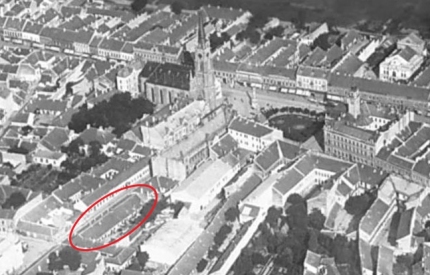
The aerial photograph taken in 1926 shows Njegoševa Street and Liberty Square, with “Bela lađa” circled in red.
After World War II, this famous tavern was closed following 150 years of operation, and in the photograph taken around 1980, we can see that the building housed the company “Novograp.”

Photograph from 1995.


Realizaciju sajta pomogala je Gradska uprava za kulturu Novog Sada

Za realizaciju ovog sajta korišćeni su izvori i materijali Zavoda za zaštitu spomenika kulture Grada Novog Sada
STARO JEZGRO NOVOG SADA je proglaseno za kulturno dobro, odlukom o utvrđivanju za prostorno kulturno-istorijsku celinu – 05 br. 633-151/2008 od 17. januara 2008, „Sl. glasnik Republike Srbije“ br. 07/2008.


